Explore Europe Differently!
A new European network, RECORB, is inviting cities, communes and regions to turn their brewing heritage into a driver of sustainable tourism, local pride and economic development. Here is why your territory should join the movement.
For centuries, beer was treated as a simple matter of taste — a drink to be enjoyed and forgotten. But across Europe, a quiet shift is under way. Behind every glass lies a territory: a commune, a region, a landscape, and generations of know-how passed from hand to hand. Turning that heritage into a genuine tourism asset is exactly the ambition of the European Network of Brewing Communes and Regions (RECORB), a non-profit association under Belgian law officially launched on 24 June 2026 at the Press Club Brussels Europe.
Beer as a Gateway to European Heritage
RECORB offers local and regional leaders a change of perspective. Rather than showcasing breweries alone, it champions entire territories — weaving together culture, heritage, gastronomy and local identity. Beer becomes the gateway to Europe’s history, landscapes and traditions.
The logic is powerful for any commune or region. Beer tourism draws visitors away from saturated tourist hotspots and towards smaller cities, rural communes and regions off the mass-tourism trail. It sustains hotels, restaurants, shops and local crafts. And because brewing follows the rhythm of harvests, festivals and seasonal traditions, it spreads visitor flows throughout the year — not just during peak weeks. This is the essence of the Beer Trips movement now reshaping European travel: authentic local discovery, slow tourism, and a spotlight on lesser-known destinations.
A European Recognition at the Right Moment
The network arrives at a pivotal time. On 28 April 2026, the European Parliament adopted MEP Daniel Attard‘s resolution on sustainable tourism — the first European parliamentary text to explicitly name beer and beer tourism, alongside wine and gastronomy, as a lever for sustainable European tourism. It also recognised the role of cities, communes and regions in rebalancing tourist flows. With the European Commission now preparing its first unified strategy for sustainable tourism, brewing heritage has secured its place on the continental agenda.
That recognition was echoed at the launch by those shaping European policy. As Benoît Cassart, Member of the European Parliament, put it: « through beer tourism, regions keep their identity and local traditions alive, support local economies and enhance the appeal of their territories. He described it as a tangible tool for promoting cultural heritage, creating jobs and strengthening territorial cohesion across Europe — with cities and regions holding a key role in preserving and showcasing this shared asset« .
A Label, a Network, a Set of Tools
At the heart of the scheme sits the « Brewing Commune » label. Modelled on the well-known « towns in bloom » scheme, it distinguishes territories according to the intensity of their brewing presence — one, two or three hops — and unites brewers, taverns, restaurateurs, guilds, museums, tourist offices and festivals under a single banner. At the launch, the Walloon municipality of Braine-l’Alleud — better known for the Battle of Waterloo — was named RECORB’s very first official Brewing Commune, proof that a territory’s legacy can be built on malt, hops and craftsmanship as much as on history. The plaque and its allotted number of hops will be presented at a ceremony in the coming weeks.
As the institutional partner of the beBeer ecosystem, RECORB draws on a suite of digital tools designed for cultural and heritage discovery: the beBeer in your pocket web app, the Beer Planner, the Beer Routes, the Beer Trips and the interactive Brasserium. Together they create a « phygital » form of tourism, where on-site experience and digital resources reinforce one another. beBeer is not a « beer network » but a European beer tourism initiative built on authentic travel experiences and sustainable discovery.
An Industry Behind the Idea
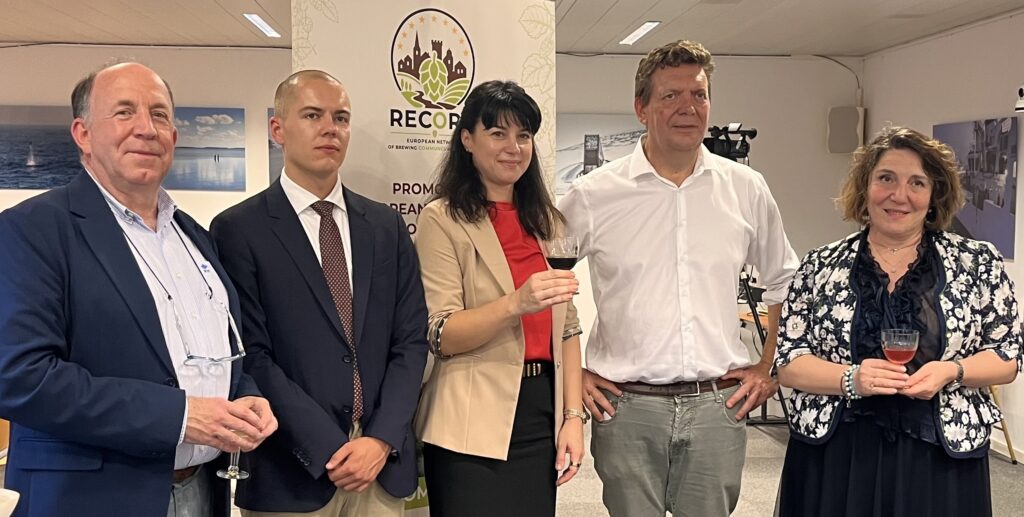
The launch at the Press Club Brussels Europe brought together the Permanent Representations to the European Union, regional representation offices in Brussels and the press, alongside European craft brewers who illustrated the continent’s brewing diversity. The initiative also drew the backing of Europe’s brewing sector. Julia Leferman, Secretary General of The Brewers of Europe, underlined that beer is more than a beverage — it is part of Europe’s cultural heritage and an important contributor to its economic future. She noted that initiatives like RECORB help strengthen the connection between breweries, communities and regions, highlighting the role of beer in supporting tourism, local development and European competitiveness.
An Invitation to Europe’s Mayors and Regional Leaders
For local and regional elected representatives, the opportunity is concrete. To join RECORB is to have your territory’s brewing heritage formally recognised, to strengthen its appeal and local economic development, and to bring your brewers, cafés, restaurateurs and cultural players together under one identity. Communes earn the « Brewing Commune » label and gain European visibility; regions can link their communes into genuine Beer Routes that stitch local ingredients, historic towns, outstanding breweries and living communities into a single journey.
Brewing heritage, in the end, is far more than the glass we share — it is a powerful driver of identity, tourism appeal and local pride for hundreds of European communes and regions.
Does your territory have a brewing story to tell? Join the movement and discover more here: www.recorb.eu